
The types of play in early childhood
A practical guide to the different types of play in early childhood and what each one builds. Includes Mildred Parten's six stages, plus the kinds of play educators plan for in centre programmes.
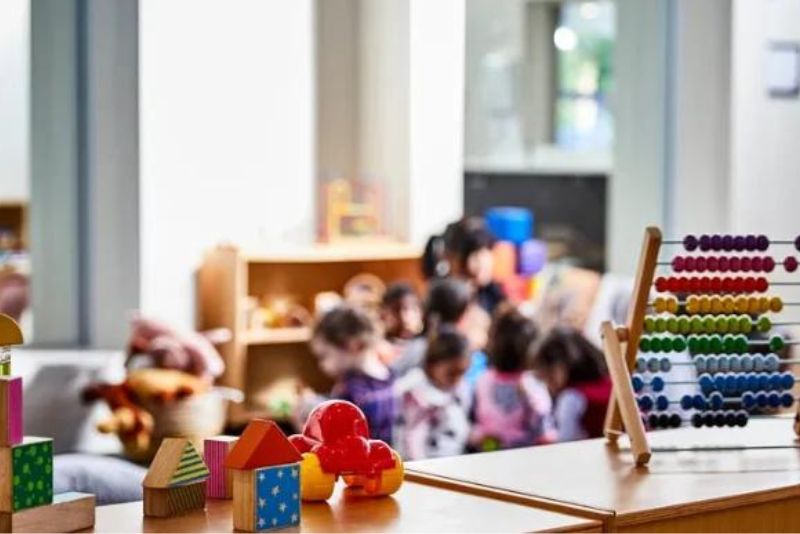
“Play” is the word everyone uses about early childhood. But it's a broad word, and the kinds of play a one-year-old does are quite different from what a four-year-old does.
Understanding the different types of play helps parents recognise what's happening when their child is “just playing”, and helps educators plan environments that support different developmental needs.
This article walks through Mildred Parten's classic stages of play, plus the practical types of play you'll see in any quality childcare setting.
Mildred Parten's six stages of play
In 1932, sociologist Mildred Parten observed children at play and identified six stages, ordered roughly from youngest to oldest. The framework is still used today.
1. Unoccupied play (birth to 3 months): a baby moves arms and legs, watches surroundings, is taking in the world. It might not look like play, but it is.
2. Solitary play (0 to 2 years): the child plays alone, focused on their own activity, not noticing others. Building, exploring, mouthing toys.
3. Onlooker play (2 to 3 years): the child watches other children play, often intently. They're learning how others play.
4. Parallel play (2 to 3 years): children play side by side, often with similar materials, but not really together. They're aware of each other and may copy.
5. Associative play (3 to 4 years): children begin to interact, share materials, talk during play. They're still mostly doing their own thing, but in a shared activity.
6. Cooperative play (4+ years): children play together with shared goals and roles. Group games, role-play scenarios, collaborative building.
Children move through these stages, but not in a strict order. A four-year-old might prefer solitary play one day and cooperative play the next. They describe what children do. They are not rules.
Practical types of play in a centre
Beyond Parten's stages, educators plan for several specific types of play that meet different developmental goals. Most quality centres offer all of these in some form.
Sensory play
Sand, water, mud, slime, dough. Sensory play develops fine motor skills, hand-eye coordination, and language as children describe what they're feeling.
Constructive play
Blocks, magnetic tiles, lego, recycled materials. Constructive play teaches problem-solving, spatial reasoning, persistence, and early engineering thinking.
Pretend or symbolic play
Dress-ups, home corner, puppets, doctor kits. Pretend play develops empathy, language, executive function (planning, switching roles), and emotional regulation. Often one of the most cognitively demanding forms of play in the room.
Physical or active play
Running, climbing, riding bikes, jumping, kicking balls. Builds gross motor skills, balance, strength, risk assessment. Outdoor environments are typically where most of this happens.
Games with rules
Board games, card games, group games like duck-duck-goose. Teaches turn-taking, fairness, handling losing, working memory. More common in older preschool rooms.
Creative or expressive play
Painting, drawing, music, dance, storytelling. Develops fine motor skills, self-expression, and emotional vocabulary.
Social or cooperative play
Group projects, collaborative building, joint storytelling. Teaches negotiation, compromise, leadership, and friendship skills.
How educators plan for different types of play
A typical room offers all these types of play simultaneously, with educators rotating which materials are on offer based on what they've been observing in the children. If they notice a child is rarely doing pretend play, they might add new dress-up costumes for the week. If children have had less running and climbing because of weather, they might rearrange the indoor space to allow more movement.
Across our 4 centres, programmes are built around these different types of play, with educators using their observations of children to plan what to put out next. The Early Years Learning Framework guides this, with play-based learning as one of its core practices.
Why it's worth understanding
For parents, recognising the type of play your child is doing helps you support it well. A child deep in solitary play doesn't need company. A child in associative play might benefit from a sibling joining in. A child in pretend play often wants you to take a role, even if you're busy cooking.
For educators, understanding these types is the foundation for planning a room that meets every child's needs over the course of a week.
If you'd like to see how this looks in practice, book a tour at one of our centres.
Talk to us
Each centre runs its own tours. Get in touch through the central form and we'll pass your message to the right director, or call our head office on 02 9487 5174.
Contact us