
What is reflective practice in childcare?
A practical explanation of reflective practice in childcare, including the three types (in-action, on-action, for-action), critical and meaningful reflection, the benefits, and concrete examples.
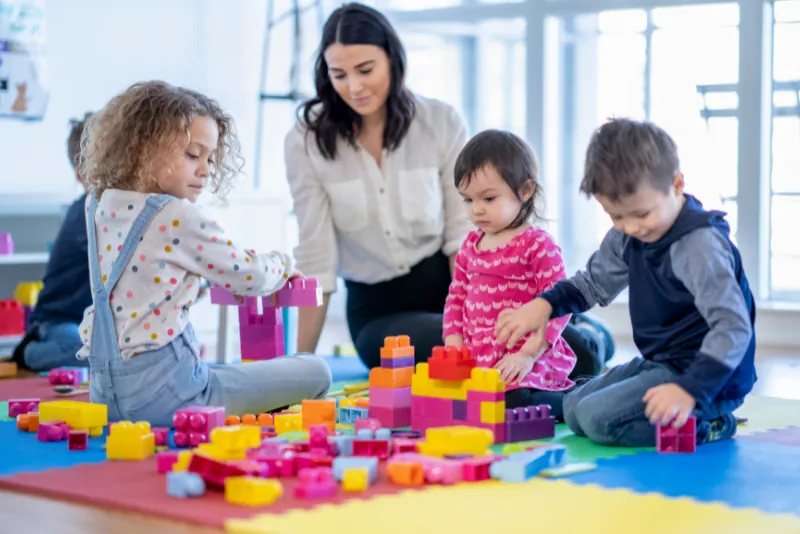
Educators in early childhood encounter dozens of moments every day that involve choices: how to respond to a child's question, how to handle a conflict between two children, how to set up the room tomorrow.
Reflective practice is the discipline of pausing, considering those moments, and using what you learn to do better next time. It's central to the way we work at Eikoh.
This article explains what reflective practice in childcare actually is, the different types, the benefits for educators and children, and what it looks like in practice.
In this article
What reflective practice is
Reflective practice means learning from everyday moments in an early childhood setting. Educators step back and ask not only what happened, but why.
This guides future decisions and helps educators improve. By looking closely at the experiences offered to children, educators can see what to repeat, what to build on, and what to change.
Reflective practice is also one of the eight Principles of the Early Years Learning Framework. It's not optional in approved Australian early childhood education. It's part of the regulatory framework.
The different types of reflection
There are three commonly recognised types of reflective practice: reflection-in-action, reflection-on-action, and reflection-for-action. Each happens at a different point relative to the moment of practice.
Reflection-in-action happens in the moment, when an educator makes decisions in response to current surroundings and the situation at hand. A child becomes upset during group time. The educator notices, reads the cues, and decides on the spot to take the child to a quieter corner with a familiar book. That's reflection-in-action.
Reflection-on-action involves thinking about experiences after the event. This gives educators the chance to ask how and why a practice helped or hindered a child's learning. Often this happens at the end of the day, in team meetings, or in the room journal. "We tried X today, and here's how it went."
Reflection-for-action is proactive thinking about future action. Educators look at different approaches and refine existing practices to improve future outcomes. "Tomorrow, when we set up the morning, we'll move the easel closer to the window so children can see what they're painting."
All three are part of the same ongoing process: observing, listening, thinking about what was observed and heard, then using the information to inform future practice.
Critical reflection
Critical reflection in childcare involves learning from everyday situations and problems by regularly asking questions of yourself and your actions. It helps educators understand how things happened, so they can plan better next time. Critical reflection is the foundation of improving practice.
The discipline encourages educators to think about their provision of education and care from alternative viewpoints, gathering information from different perspectives to gain a deeper understanding. This helps identify an educator's strengths and highlight areas where there's room for improvement.
Critical reflection often involves uncomfortable questions. Why did I respond to that child the way I did? Was there a bias in how I read the situation? Would I have done the same if it had been a different child? These questions are part of the work.
Meaningful reflection
Meaningful reflection involves thoughtful consideration and analysis of an educator's actions, decisions, and interactions with the children in their care. By encouraging educators to examine the underlying principles, values, and outcomes of their teaching methods, meaningful reflection improves the quality of care given.
It's not the same as journalling or simply describing what happened. Meaningful reflection asks "what does this tell me about my values, my assumptions, and my next steps?"
The benefits
The goal of reflective practice in childcare is to gain a better understanding of teaching and learning, in order to improve the teaching practice. The benefits show up across the whole centre community:
- It provides evidence of where improvements are needed
- It helps identify barriers that may be affecting an individual child's ability to learn effectively
- It encourages change by forcing educators to stop and think about their actions
- It promotes self-awareness, which leads to better teaching
- It gives children the benefit of educators who understand their strengths and abilities
- It creates a culture of professional growth in the team
Strong reflective-practice cultures are often associated with higher educator job satisfaction. That's good for children too, because research consistently links stable teams with quality early childhood education.
Examples in practice
How does reflective practice look on a typical day at one of our centres?
Reviewing interactions. Reflecting on things that happened and considering what worked and what could be improved. For example, analysing how an educator handled a conflict between two children. Noticing the moment is the first step. Going deeper, by asking another educator what they think or by writing it down, deepens the analysis.
Asking questions to extend thinking. Reflective educators don't just answer children's questions, they ask questions back that help children explore and expand on their ideas. "What do you think would happen if...?" or "Why do you think the leaves fall down and not up?" Verbal instruction is part of the toolkit, but so is the well-timed question.
Genuine interest in children's communication. Showing real interest when a child expresses their feelings helps build their self-confidence in communicating how they feel. Educators who are reflective are usually more attuned to this kind of moment.
Monitoring progress with intent. Tracking each child's progress provides a supportive framework for them to approach challenges and grow. The OWNA app, regular reports, and team meetings all support this work.
A weekly reflection example
Here is what a short weekly room reflection can look like in practice. What we noticed: the block corner was crowded every day after lunch, and most of the week’s conflicts happened there in that half hour. What we think it means: the interest is bigger than the space, and waiting for a turn is the trigger, not the blocks themselves. What we changed: we moved the block area to the larger mat near the window and added a second basket of loose parts alongside it. What happened next week: the crowding eased, the same children stayed longer at the play, and we recorded two extended constructions on OWNA. Four sentences, one concrete change, one observed result. That is a complete weekly reflection.
A critical reflection example
Critical reflection asks a harder question about the same week: not "did the room run smoothly?" but "who did the routine work for, and who did it not?" For example: our progressive morning tea assumed children would come when called. One child never came unprompted, and on reflection the educators realised the routine relied on verbal cues in English that this child was still learning. The change was a visual cue card and a peer invitation, and the deeper lesson was about whose communication styles our routines quietly favour. That move from a practical fix to questioning an assumption is what makes reflection critical.
A note on educator wellbeing
Reflective practice can also support educator wellbeing. A 2019 long-term study published in Frontiers in Psychology on early childhood educators in Italian multi-age classrooms found that 10 months of reflective-practice training improved teachers' confidence, sense of belonging, and feeling of control over their work. The teachers initially felt the multi-age room made teaching difficult and ineffective. After the training, those perceptions had changed.
Reflective practice isn't only about improving outcomes for children. It also helps educators feel more in control of their work and more confident in their judgement. That matters for retention, which matters for children.
Conclusion
By engaging in reflective practice, educators refine their approach and the quality of care given to children, contributing to positive outcomes in early childhood. It's not a one-off task. It's a continuous discipline that runs through how a team plans, teaches, and reviews.
If you'd like to find out more about how this looks at one of our four northern Sydney centres in Normanhurst, St Ives, Roseville, or West Ryde, please get in touch.
Talk to us
Each centre runs its own tours. Get in touch through the central form and we'll pass your message to the right director, or call our head office on 02 9487 5174.
Contact us